

Vibration Plate Exercises: 10 Moves and a 4-Week Beginner Plan
By the HEALTHandMED team, Cedar City, Utah. Reviewed by Dr. Terrance M. Cooper, D.C., HEALTHandMED's Consulting Physician. Updated October 30, 2026.
The easiest way to start on a vibration plate is with a few simple moves on a low setting. Begin with about 10 minutes, three times a week. Hold each exercise for 30 to 60 seconds, rest for 30 seconds between moves, and keep your knees soft in every standing position. Over four weeks, build up to 15 to 30 minutes as the moves start to feel familiar.
Below are 10 beginner-friendly vibration plate exercises with step-by-step form tips, a 4-week plan, and the settings to start on for every GForce and Vibra Pro machine we sell. Every move works on a standing plate, from the portable GForce Portable 3D to column machines with handlebars like the GForce Pro. Still choosing a machine? Start with our Best Vibration Plate for Home Use guide, or call Dr. Cooper for free personal advice (details below).
Personal guidance from Dr. Cooper
Dr. Terrance M. Cooper is a retired chiropractor and has been HEALTHandMED's Consulting Physician since 2009. In that time he has helped hundreds of people understand and use standing vibration exercise machines. Over his career he has worked with people of all ages and activity levels, often alongside their medical doctors, so he understands the questions people have before they start.
No two people have exactly the same needs. Some want a simple way to stay active at home, while others have questions about using a machine around their own physical limits. Dr. Cooper can explain how to position yourself on the plate, which settings to start on and how to get the most from your machine. His goal is to help you use your equipment with confidence, alongside the care you receive from your own doctor.
Why people add vibration exercise to their routine
- Your muscles stay busy. Holding even a simple squat on a moving plate keeps your legs and core working.
- It challenges your balance. Every standing move asks you to stay steady and stable.
- It adds variety. Strength, stretching and mobility moves all fit into one short session.
- It is low impact. You hold positions instead of jumping or running, at a speed you choose.
- It fits your day. Ten to thirty minutes at home, three or four times a week.
What you get from vibration exercise depends on you, your machine and how you use it. It works best as an addition to walking, strength training and stretching, not as a replacement for regular activity or for any medical care.
Before you step on
- Read your manual and check your machine's maximum user weight.
- Pick your footwear and keep it the same. Flat, soft-soled shoes and bare feet both work. Shoes change how much movement you feel, so make the same choice each session.
- Keep your knees slightly bent in every standing move. Soft knees let your legs take up the movement, so the vibration stays in your lower body instead of traveling up to your head.
- Stand tall, with your head up and your jaw relaxed. If you feel the vibration in your head, lower the speed or bend your knees a little more.
- Start in oscillating (side-to-side) mode at a low speed. On a dual-motor machine, add the second motion once the moves feel comfortable.
- Hold the handlebars, arm bands or straps while you get used to the motion.
Using your plate safely
A vibration plate is easy to enjoy at your own pace, and a few simple habits keep every session comfortable:
- Start at the lowest speed and keep your first sessions short, around 10 minutes.
- Build up your time and speed gradually over several weeks.
- Stay within your machine's weight rating.
- Step off and rest if you feel dizzy or uncomfortable.
Talk to your medical doctor before you start, and you are welcome to talk to Dr. Cooper too, if you are pregnant, have a pacemaker or other implanted device, have had a hip or knee replacement or any recent surgery, have a recent fracture, or have a medical condition or significant pain. Step off and rest if you feel any pain or dizziness.
10 vibration plate exercises for beginners
For general fitness, these ten moves are a great place to start. The times below are for your first few weeks. Step on and off with a hand on the handlebar or column if your machine has one, and keep breathing steadily through every hold.
1. Static squat
Focus: thighs and glutes. Time: 30 to 60 seconds.
Stand with your feet hip-width apart. Sit back as if onto a chair until your thighs are about halfway to parallel, with your weight in your heels and your chest up. Hold the position and keep your knees in line with your toes.
2. Slow squat
Focus: thighs and glutes. Time: 30 to 60 seconds.
From the same starting stance, lower into the squat over a count of three, then rise over a count of three. Stop just before your knees straighten at the top, so they stay soft for the whole set.
3. Calf raise
Focus: calves and ankles. Time: 30 seconds.
Stand tall with soft knees and your feet hip-width apart. Rise onto the balls of your feet, pause, and lower your heels slowly. Hold the handlebar or arm bands for balance.
4. Split stance
Focus: front thigh and hips. Time: 30 seconds each side.
Place one foot in the center of the plate and the other on the floor behind you. Bend both knees slightly, keeping your front knee over your ankle and your back straight. Switch sides.
5. Wide-stance squat
Focus: inner thighs and glutes. Time: 30 to 60 seconds.
Stand with your feet wider than your hips and your toes turned out a little, then lower about halfway and hold. On an oscillating plate, a wider stance also gives a bigger movement, so bring your feet slightly closer if it feels strong.
6. Push-up hold
Focus: chest, shoulders and arms. Time: 20 to 30 seconds.
Kneel on the floor facing the plate and place your hands on it, shoulder-width apart. Hold the top of a push-up with your elbows slightly bent and your body in a straight line. Move from your knees to your toes when you are ready.
7. Forearm plank
Focus: core and shoulders. Time: 20 to 30 seconds.
Rest your forearms on the plate with your elbows under your shoulders. Keep your body in a straight line from your head to your knees, or to your heels for a stronger hold.
8. Triceps dip
Focus: back of the arms. Time: 20 to 30 seconds.
Sit on the floor with your back to the plate and place your hands on its edge behind you, fingers pointing forward. Bend and straighten your elbows slowly through a small, comfortable range.
9. Seated calf rest
Focus: calves, as a cool-down. Time: 60 seconds.
Sit on a sturdy chair facing the plate and rest your calves or the backs of your heels on it. Relax your legs and breathe slowly. It is a pleasant way to finish any session.
10. Standing hamstring stretch
Focus: back of the legs. Time: 30 seconds each side.
Stand facing the plate and place one heel on it, with that leg straight but not locked. Hinge gently forward from your hips with a long back until you feel a comfortable stretch. Switch sides.
4-week vibration plate workout plan for beginners
Work through the exercises in order, then repeat the list to fill your time on the plate.
| Week | Sessions | Exercises | Time on the plate | Setting |
|---|---|---|---|---|
| 1 | 3 a week | 1, 3, 6, 9 | About 10 minutes | Lowest oscillating speed |
| 2 | 3 a week | 1, 2, 3, 6, 7, 9 | 12 to 15 minutes | Low |
| 3 | 3 to 4 a week | 1 to 7, 9, 10 | 15 to 20 minutes | Low to medium |
| 4 | 3 to 4 a week | All 10 | 20 to 30 minutes | Medium, if comfortable |
Rest for 30 seconds between exercises, and leave a day between sessions in the first two weeks. If a week feels like a lot, simply repeat it before moving on. Once the plan feels easy, hold the arm bands or upper body straps that come with your machine during the static squat and add a slow biceps curl.
Vibration plate settings to start on, machine by machine
- GForce Portable 3D: start in oscillating mode at a low speed, then try linear mode, and the combined mode once both feel familiar. The Bluetooth remote lets you change the speed without stepping off.
- GForce Portable 1500W: start in manual oscillating mode, then add triplanar motion. When you find a routine you like, save it in one of the three user-defined programs.
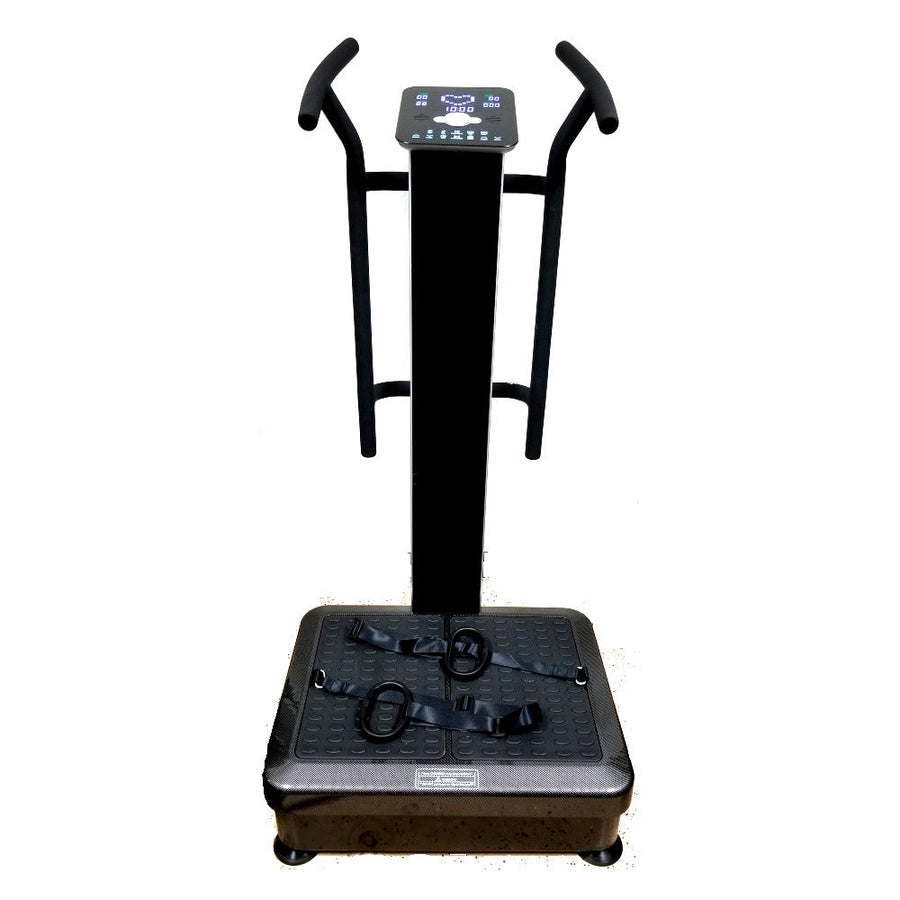
- GForce Pro, GForce Pro DX and GForce Pro Cardio: the same nine modes as the Portable 1500W, plus handlebars for every move above. Each one comes with our exercise chart, and set-up and exercise videos are on our YouTube channel.
- Vibra Pro Slim M7: start with oscillation at a low speed, then explore the other six motions one at a time, using the remote to switch speeds and programs.
- Vibra Pro Genesis Sport X8: start with oscillation at a low speed. It comes with an exercise DVD of 8 workouts and a wall poster of 25 exercise positions, and optional Vibra Pro trainer cards run a guided session for you.
- Vibra Pro Slim M1: made for seated use. Sit in a chair with your feet on the platform, or rest your calves on it as in exercise 9, and choose from 5 preset workouts and 20 speeds.
Curious what each motion does? Our guide to the types of vibration plates explains oscillating, linear and triplanar motion.
Vibration plate exercise chart

Every GForce Pro, Pro DX and Pro Cardio includes our exercise chart, and you can buy the Whole Body Vibration Machine Exercise Chart on its own for $19.98. Designed for dual-motor machines, it covers strength, stretch and relaxation exercises and includes a quick reference to the two motions, so your next move is always in view.
Free personal consultation with Dr. Cooper
Have a question about your vibration machine? Dr. Cooper offers free phone consultations to HEALTHandMED customers. Whether you are just starting a vibration exercise routine, want help with your settings, or are still deciding which machine suits you best, he is happy to share his experience and explain the differences between our machines.
Dr. Terrance M. Cooper, D.C. (retired), Consulting Physician for HEALTHandMED. Call him on 435-531-9418.
Dr. Cooper's guidance is educational. It is not a medical diagnosis, treatment or individual rehabilitation advice. If you have medical concerns, especially after surgery, talk to your healthcare professional before you begin vibration exercise.
Frequently asked questions
What is the best vibration plate exercise for beginners?
The static squat. Stand with your feet hip-width apart, sit back halfway as if onto a chair, keep your knees soft and hold for 30 to 60 seconds on a low setting. It gets you used to the movement before you add other moves.
How long should you stand on a vibration plate?
Start with about 10 minutes in total, broken into 30 to 60 second exercises with short rests in between. Build up to 15 to 30 minutes over a few weeks.
How often should you use a vibration plate?
Three to four sessions a week suits most beginners, with a day between sessions while you are starting out.
Should your knees be bent on a vibration plate?
Yes. Keep them slightly bent in every standing exercise so your legs take up the movement.
Can you use a vibration plate barefoot?
Yes, many people do. Whichever you choose, keep it the same each session, because shoes change how much vibration you feel.
Can I do these exercises on a portable plate?
Yes. All 10 moves work on portable plates such as the GForce Portable 3D and the Vibra Pro Slim M7, which both have a roomy 31 x 18 inch platform. Hold the included arm bands or straps for stability.
Who should check with a doctor before using a vibration plate?
Talk to your doctor first if you are pregnant, have a pacemaker or other implanted device, have had a hip or knee replacement or recent surgery, have a recent fracture, or have a medical condition. Dr. Cooper is also happy to answer your questions by phone.
Do I need a machine with handlebars?
No, but many people like them. Handlebars give you a steady grip as you step on and off and during standing moves. The GForce Pro family and the Vibra Pro Genesis Sport X8 both have them.
Find your machine
Browse every GForce and Vibra Pro model in our whole body vibration machines collection, or call our US-based team in Cedar City, Utah at 1-888-649-3650 for help choosing a machine and getting started. For personal advice on using your machine, call Dr. Cooper on 435-531-9418.
More guides: Best Vibration Plate for Home Use (2026 Buyer's Guide), GForce vs Vibra Pro: Which Vibration Machine Is Right for You? and Types of Vibration Plates: Oscillating, Linear and Triplanar Motion Explained.