

Types of Vibration Plates: Oscillating, Linear and Triplanar Motion Explained
By the HEALTHandMED team, Cedar City, Utah. Updated October 21, 2026.
There are three main types of vibration plate motion. On an oscillating plate (also called pivotal or side-alternating), the platform rocks side to side like a see-saw. On a linear plate (also called vertical), the whole platform moves straight up and down. Triplanar motion moves the platform in small, quick steps, which GForce describes as a spiral motion. Many machines are dual motor and let you run two motions alone or together, and Vibra Pro adds more motion styles, up to seven on a single plate.
Two numbers describe how any motion feels: frequency, in hertz (Hz), and amplitude, in millimeters (mm). Below, we explain each type, list the published numbers for the GForce and Vibra Pro machines we sell, and help you match a motion style to the way you like to work out. Prices are as of October 2026.
Vibration plate types at a glance
| Motion | How the plate moves | What it feels like | Our machines that offer it |
|---|---|---|---|
| Oscillating (pivotal, side-alternating) | Pivots around its center, so one side rises as the other drops | A rocking, side-to-side rhythm; a wider stance gives a bigger movement | Every new GForce machine, plus the Vibra Pro Slim M7, Genesis Sport X8 and Slim M1 |
| Linear (vertical) | The whole platform moves up and down together | An even, up-and-down movement under both feet | GForce Portable 3D and GForce Mini 500W (Like New) |
| Triplanar | Small, quick steps, described by GForce as a spiral motion | A fast, fine vibration | GForce Portable 1500W, GForce Pro, Pro DX and Pro Cardio; soft triplanar on the Vibra Pro Slim M7 and Genesis Sport X8 |
| Combined (dual mode) | Two motors running at the same time | Both motions layered together | Every new GForce machine |
| Vibra Pro multi-motion | Spiral rotational, cross lateral, dynamic wave, Mobius and multi-axis patterns | A different pattern for each motion, to switch between | Vibra Pro Slim M7 (seven motions) and Genesis Sport X8 (three motions) |
Oscillating (pivotal) vibration plates
On an oscillating plate, the platform pivots around its center, so one foot rises as the other drops. Because the plate tips around the middle, where you stand changes the feel: feet close together give a small movement, and a wider stance gives a bigger one, just as a seat farther out on a teeter-totter travels farther. That makes it easy to adjust the intensity without touching the controls.
Oscillating motion runs at lower frequencies with larger movements: from 5 Hz up to 22 Hz on our GForce machines, with up to 10 to 13 mm of movement. Many people start here, at a low speed, because the rhythm is easy to follow. Every new GForce machine has an oscillating motor, and so do the Vibra Pro Slim M7, the Vibra Pro Genesis Sport X8 and the seated Vibra Pro Slim M1.
Linear (vertical) vibration plates
A linear plate moves the whole platform straight up and down, so both feet rise and fall together. It feels steady and even, and your stance width does not change the size of the movement the way it does on an oscillating plate.
Linear machines vary a lot, which is why the published numbers matter. The GForce Portable 3D runs its linear motion at 3 to 10 Hz with up to 15 mm of movement, a slower and deeper motion. The GForce Mini 500W (Like New) runs at 5 to 42 Hz with 1 to 5 mm, a faster and finer one. Both are linear, yet they feel quite different under your feet.
Triplanar and spiral motion
Triplanar motion moves the plate in small, quick steps instead of a big rocking motion. GForce describes it as a spiral motion with a smaller amplitude. On the GForce Portable 1500W it runs at 15 to 40 Hz with up to 2 mm of movement, and on the GForce Pro at 15 to 45 Hz with 2.5 mm. The GForce Pro DX and GForce Pro Cardio use the same 500 W triplanar motor as the GForce Pro.
Triplanar motion feels like a fine vibration rather than a rock, and many people add it once oscillating motion feels comfortable. Vibra Pro's soft triplanar, on the Slim M7 and Genesis Sport X8, is the brand's own version, with 13 mm of movement listed on the Slim M7.
Dual-motor and multi-motion machines
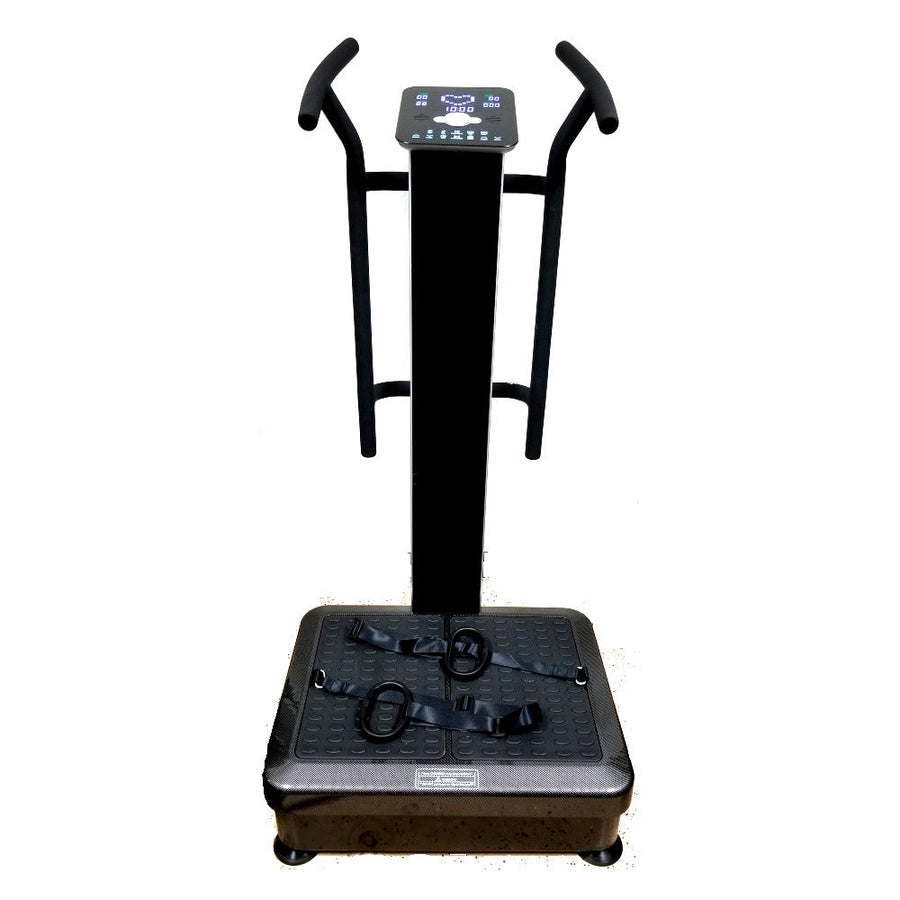
A dual-motor machine has a separate motor for each motion, so you can run either motion on its own or both together. Every new GForce machine is dual motor. The GForce Portable 3D pairs oscillating with linear motion, and the GForce Portable 1500W and GForce Pro family pair oscillating with triplanar. On the Portable 1500W and every GForce Pro model, nine operating modes cover each motion on its own, the two combined, three automatic programs and three user-defined programs for saving your own routine.
Vibra Pro takes variety further. The Vibra Pro Slim M7 uses three motors (440 W, 220 W and 200 W) for seven motions: oscillation, spiral rotational, cross lateral, soft triplanar, dynamic wave, Mobius and multi-axis. The Vibra Pro Genesis Sport X8 offers oscillation, spiral rotational and triplanar motion, each at high or low amplitude, with 120 speed settings and optional trainer cards that set the motion, speed and time for you during a guided session.
Published frequency and amplitude for our machines
| Machine and motion | Frequency | Amplitude |
|---|---|---|
| GForce Portable 3D, oscillating | 5 to 11 Hz | Up to 13 mm |
| GForce Portable 3D, linear | 3 to 10 Hz | Up to 15 mm |
| GForce Portable 3D, combined | 8 to 21 Hz | Up to 15 mm |
| GForce Portable 1500W, oscillating | 5 to 14 Hz | Up to 10 mm |
| GForce Portable 1500W, triplanar | 15 to 40 Hz | Up to 2 mm |
| GForce Pro, oscillating | 5 to 22 Hz | Up to 11 mm |
| GForce Pro, triplanar | 15 to 45 Hz | 2.5 mm |
| GForce Pro, combined | 25 to 50 Hz | 1 to 10 mm |
| GForce Mini 500W (Like New), linear | 5 to 42 Hz | 1 to 5 mm |
| Vibra Pro Slim M7, seven motions | 60 speed settings per motor | 2 mm (spiral rotational) to 33 mm (dynamic wave) |
For the full side-by-side of weight ratings, platforms, handles and warranties, see our Best Vibration Plate for Home Use guide.
Frequency and amplitude, explained
Frequency is how many times per second the plate moves, measured in hertz (Hz). Amplitude is how far it moves each time, measured in millimeters (mm). Together they decide how strong a motion feels: a low frequency with a large amplitude feels like a slow, deep rocking motion, while a high frequency with a small amplitude feels like a quick, fine vibration.
Speed levels sit on top of these numbers. The GForce Portable 1500W, for example, has 60 speed settings for each motion: its oscillating speeds cover 5 to 14 Hz, and its triplanar speeds cover 15 to 40 Hz. When you compare machines, look for the frequency and amplitude of each motion, not only the number of speed levels. If a listing shows speed levels alone, our team is happy to help you compare.
Does wattage tell you the type?
No. Wattage tells you how much motor power drives the plate, not how the plate moves. The GForce Portable 3D and GForce Portable 1500W both run 1,500 W across two motors, yet one pairs oscillating with linear motion and the other pairs oscillating with triplanar. Check the motion types first, then frequency and amplitude, then power.
Which type suits you?
- Oscillating and linear on one plate: the GForce Portable 3D ($389.98), with a 31 x 18 inch platform and a Bluetooth remote.
- Oscillating and triplanar: the GForce Portable 1500W ($609.98) as a portable plate, or the GForce Pro, Pro DX or Pro Cardio ($2,345.98 each) with handlebars and a steel body.
- The most motion styles: the Vibra Pro Slim M7 ($687.98), with seven motions on a portable plate, or the Vibra Pro Genesis Sport X8 ($3,186.98), with three motions, handlebars and a 3-year warranty on electrical components.
- Seated use: the Vibra Pro Slim M1 ($253.98), an oscillating plate with rollers, made for use while sitting.
Prefer to compare by brand? Our GForce vs Vibra Pro guide sets every model side by side.
Using a vibration plate safely
- Start in oscillating mode at the lowest speed, with first sessions around 10 minutes.
- Keep your knees slightly bent in every standing exercise.
- Hold the handlebars or straps until the motion feels familiar.
- Stay within your machine's weight rating, and step off if you feel dizzy or uncomfortable.
Check with your doctor first if you are pregnant, have a pacemaker or other implanted device, have had recent surgery, or have a medical condition. For moves to try on any type of plate, see our vibration plate exercises guide.
Frequently asked questions
What are the different types of vibration plates?
Oscillating (pivotal), linear (vertical) and triplanar. Many machines are dual motor and offer two of them, and Vibra Pro adds motions such as spiral rotational, cross lateral and dynamic wave.
Is oscillating or linear vibration better?
Neither is better; they feel different. Oscillating motion rocks side to side, and you can make it bigger or smaller by changing your stance. Linear motion moves both feet up and down together. Many people start with oscillating motion at a low speed, and the GForce Portable 3D gives you both on one plate.
What do Hz and mm mean on a vibration plate?
The Hz figure is the frequency, or how many times per second the plate moves. The mm figure is the amplitude, or how far it moves each time. Look for both numbers for each motion when you compare machines.
Is a dual-motor vibration plate worth it?
If you like variety, yes. Two motors give you two motions plus a combined mode, so you can switch between a rocking rhythm and a finer vibration in one session. Every new GForce machine is dual motor.
Compare machines by motion
See every GForce and Vibra Pro model in our whole body vibration machines collection, or call our US-based team in Cedar City, Utah at 1-888-649-3650 to talk through which motion suits you.
More guides: Vibration Plate Exercises: 10 Moves and a 4-Week Beginner Plan, Best Vibration Plate for Home Use (2026 Buyer's Guide) and GForce vs Vibra Pro: Which Vibration Machine Is Right for You?.