

Does Ionic Foot Detox Work? What the Research Says
By Mark Axelson, founder of HEALTHandMED, who oversaw the design of the IonizeMe range (B.S. Biomedical Engineering, MBA). Reviewed by Dr. Terrance M. Cooper, D.C., 43 years in practice. Updated October 27, 2026.
Researchers have been exploring ionic foot baths for more than twenty years. Their studies have measured metals in urine and blood around foot bath sessions, the chemistry of the bath water, and relaxation and mood, and they report encouraging early results. This page brings those studies together. For each one, we share who ran it, how many people took part, what was measured and what the researchers reported.
HEALTHandMED designs and builds the IonizeMe ionic foot bath, and we follow this research closely. The studies used a range of ionic foot bath machines, so they describe ionic foot baths in general.
Why people and practitioners use ionic foot baths
An ionic foot bath session is simple. You sit back for 30 minutes with your feet in a tub of warm, lightly salted water, while the machine passes a direct current through a metal array in the water.
For many people, it is a calming ritual and a regular part of their wellness routine. It is a quiet half hour to sit down, slow down and put your feet up. Many people read during a session, and many simply rest.
Practitioners offer sessions in chiropractic and massage clinics, day spas, salons and wellness studios. It fits naturally alongside a service their clients already enjoy, and a dual-channel machine lets two clients relax side by side.
People are also curious about what happens during a session. That curiosity has led researchers to take a closer look.
What researchers have measured
Researchers have taken measurements in urine, blood and the bath water itself. These four studies measured metals or other substances.
| Study | Who ran it | People | What was measured | What the researchers reported |
|---|---|---|---|---|
| Study 1: Aluminum in urine (described in 2020) | A neurologist in London, as described by Dr. Dietrich Klinghardt on the BetterHealthGuy podcast, episode 127 (ref 1) | 20 | Aluminum in urine, collected every 2 hours after a session, and aluminum in the bath water | A very large peak in urine aluminum between 8 hours and 3 days after the session. Aluminum in the bath water did not rise. |
| Study 2: Metals in blood (2008) | Tara Wass, PhD, and Kaia Gallagher, PhD, Center for Research Strategies (ref 2) | 31 adults, aged 21 to 77 | Aluminum, arsenic, cadmium, lead and mercury in whole blood, measured by ICP-MS lab testing before and after 12 weeks of two foot bath sessions a week, with meditation during each session and a mineral drink afterwards | Average blood aluminum fell from 79.8 to 43.1 parts per billion (46% lower), and average blood arsenic from 4.6 to 3.5 parts per billion (24% lower). The researchers reported both changes as statistically significant. |
| Study 3: Metals in urine (2017) | A preliminary study report (ref 3) | 2 men, aged 35 and 69 | A panel of metals in ten 24-hour urine collections, tested by Genova Diagnostics: 5 days before and 5 days after one 30-minute foot bath session | Total metal output in urine over the 5 days after the session was 155% higher than in the 5 days before for one man, and 62% higher for the other. |
| Study 4: Glyphosate in urine, a controlled pilot (2018) | T.L. Hirning and E.G. Copeland (ref 4) | 19 (10 in the foot bath group, 9 in a comparison group) | Glyphosate in urine, across 12 foot bath sessions over 30 days. Glyphosate is the weed killer ingredient in Roundup. | Average urine glyphosate fell 48% in the foot bath group, compared with 14% in the comparison group. |
The bath water and other measurements
- How the water changes. An ionic foot bath passes a direct current through lightly salted water using a metal array. A technical note on electrode chemistry explains that reactions at the electrodes change the levels of hydrogen and hydroxide ions, and the pH, in the water (ref 5). The IonizeMe's live display shows the volts and amps driving these reactions throughout every session.
- Skin exchange. A 2004 study by Carlos A. Lopez-Moreno, MD, reported detecting urea and glucose in foot bath water (ref 6).
- Red blood cells. A peer-reviewed pilot by M.C. Purnell, M.B.A. Butawan and R.D. Ramsey, published in Physiological Reports in 2018, tested a "bio-field array" in 20 adults. The researchers reported changes in the appearance of red blood cells and in serum carbon dioxide (CO2) after six sessions (ref 7).
- Water structure. G.H. Pollack's book The Fourth Phase of Water describes "exclusion zone" water. Dr. Klinghardt has connected ionic fields and infrared light with Pollack's work, which offers theoretical background for this field (ref 8).
Where the research is heading
Interest in ionic foot bath research is growing. These early studies point to areas that researchers are continuing to explore, from measurements in urine and blood to the chemistry of the bath itself. We look forward to new studies building on them. Full references are listed below.
Relaxation and wellbeing studies
Relaxation is a big part of why people enjoy ionic foot bath sessions, and two pilot studies have looked at it directly.
- Heart rate variability (ref 9). A preliminary pilot measured heart rate variability, the natural variation in time between heartbeats, before and after foot bath sessions in six people. The report also describes three people who had sham (placebo) sessions for comparison. It reported lower stress-related scores in most participants.
- Mood and brain waves (ref 10). In 2002, James V. Hardt, PhD, of the Biocybernaut Institute in San Francisco ran a single-blind crossover pilot with 30 adult volunteers, 16 men and 14 women aged 18 to 77. Each person had two 35-minute warm foot baths on separate days, one active and one sham with the power disconnected, without being told which was which. That way, every participant served as their own comparison. During the active foot bath, people rated themselves as friendlier, more energetic and clearer-thinking than during the sham, and afterwards their anxiety scores were lower.
Together, these two pilots are an encouraging start for research into the relaxing side of ionic foot baths. It is an area we look forward to seeing explored further.
Why practitioners choose IonizeMe
- Engineering-led design. Mark Axelson, HEALTHandMED's founder, holds a B.S. in Biomedical Engineering and an MBA, and oversaw the design of the IonizeMe range.
- Made in the USA. IonizeMe machines are made in the USA by HEALTHandMED, based in Cedar City, Utah, where warranty repairs are carried out.
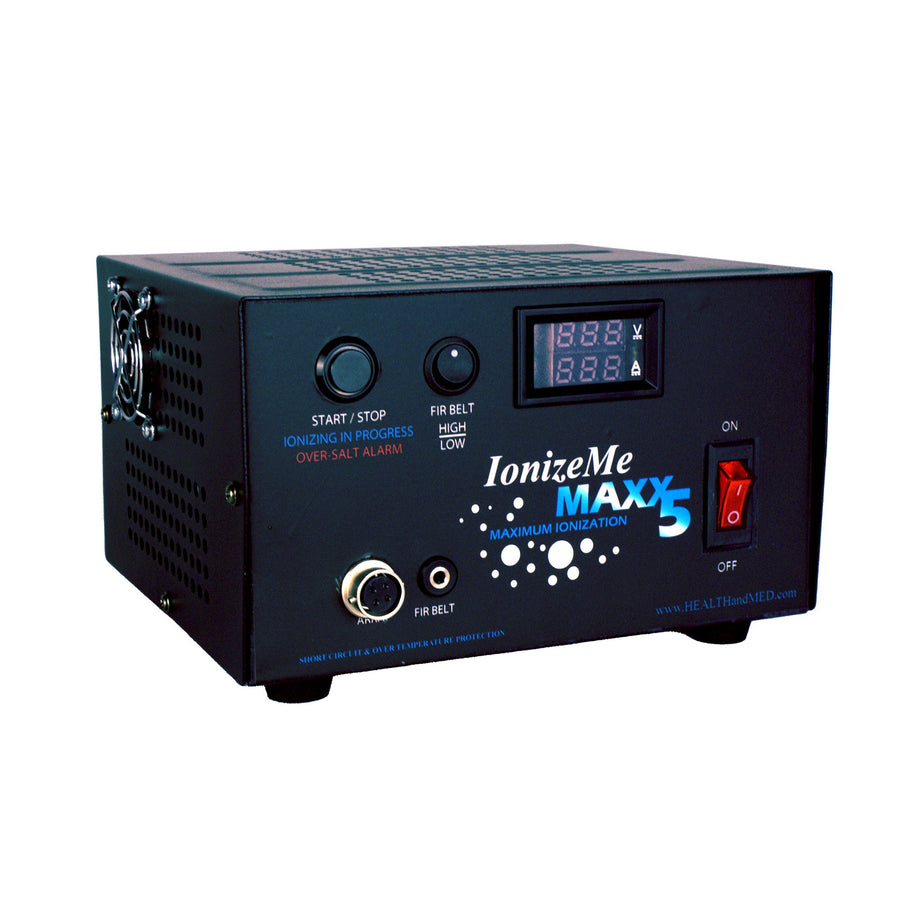
- Output you can see. A live display shows volts and amps throughout the session, with a 30-minute timer.
- A model for every setting. The IonizeMe Maxx runs one person at up to 24 volts and 2.5 amps. The Maxx 5 delivers up to 24 volts and 5 amps, and has a high and low heat switch for the optional far infrared belt. The Maxx Dual runs two people at once, on two channels, each with its own display and timer.
- No wrist strap. No IonizeMe machine uses a wrist strap, which makes every model easy to operate.
- 5-year warranty. Every IonizeMe machine carries a 5-year warranty for the original purchaser, and all three models are certified under Part 15 of the FCC Rules.
- Business Packages for practices. Built on the Maxx Dual or Maxx 5, each Business Package adds a business consultation with Dr. Cooper, a launch guide, 20 client handbooks and a year of consumables.
- Experience behind the support. Dr. Terrance M. Cooper, D.C., HEALTHandMED's Consulting Physician since 2009, has 43 years in practice and gave more than 1,800 ionic foot bath sessions in his own chiropractic clinic. Every IonizeMe package includes a free phone consultation with him.
- Low running costs. On the Maxx and Maxx Dual, arrays and liners come to about $0.65 to $0.92 per session (prices on healthandmed.com, October 2026).
- Rated by owners. The IonizeMe Maxx is rated 4.66 out of 5 from 107 owner reviews on healthandmed.com (October 2026).
Choosing a machine for home? See our Best Ionic Foot Bath for Home Use guide. Setting up a practice? Read Dr. Cooper's guide, How to Add an Ionic Foot Bath Service to Your Practice.
Enjoying sessions safely
A few simple checks help everyone enjoy their sessions with confidence.
Ionic foot baths are not recommended for:
- organ transplant recipients
- people who experience epileptic seizures
- women who are pregnant or nursing
- children under 6 without adult supervision
- anyone taking medication for anxiety or schizophrenia
If you have a cardiac pacemaker, keep the machine and all electronics at least six inches away from your chest.
Before your first session:
- If you have a heart condition, check with your doctor first.
- If you take prescription medication, check with your doctor first.
- If you have low blood sugar, eat something before your session.
Practitioners: ask every new client about these points before their first session, and keep a simple intake form. Questions? The free phone consultation with Dr. Cooper, included with every IonizeMe package, is a good place to ask.
Frequently asked questions
Does ionic foot detox work? Researchers have been exploring that question for more than twenty years. Studies have measured metals in urine and blood around ionic foot bath sessions, the chemistry of the bath water, and relaxation and mood, and they report encouraging early results. The studies above list who ran each one, how many people took part and what they reported.
What is an ionic foot bath session like? You sit comfortably with your feet in a tub of warm, lightly salted water for 30 minutes. The machine passes a direct current through a metal array in the water. Many people use the time to read or simply rest.
Who uses ionic foot baths? People who enjoy a relaxing half hour at home as part of their wellness routine, and practitioners such as chiropractors, massage therapists, day spas, salons and wellness studios, who offer sessions to their clients.
Which IonizeMe is right for me? The Maxx suits one person at home. The Maxx 5 offers the highest output, up to 5 amps. The Maxx Dual runs two people at once, and the Business Package, built on the Maxx Dual or Maxx 5, is made for practices. See our Best Ionic Foot Bath for Home Use guide and the Business Package versions.
References
- Klinghardt D. London neurologist aluminum urine study, described on the BetterHealthGuy podcast, episode 127. 2020. https://www.betterhealthguy.com/episode127
- Wass T, Gallagher K. Center for Research Strategies. Research report on heavy metal levels in whole blood and ionic foot bath sessions. 2008.
- Preliminary study of heavy metal excretion in urine after an ionic foot bath session. Research report. 2017.
- Hirning TL, Copeland EG. Footbath detox and glyphosate excretion. 2018.
- How Ions Are Produced. Technical note citing Shakhashiri BZ. Chemical Demonstrations: A Handbook for Teachers of Chemistry, Vol. 4. University of Wisconsin Press. 1992. p. 156.
- Lopez-Moreno C. Transdermal Exchange Study. 2004.
- Purnell MC, Butawan MBA, Ramsey RD. Bio-field array: a dielectrophoretic electromagnetic toroidal excitation to restore and maintain the golden ratio in human erythrocytes. Physiological Reports. 2018;6(11):e13722.
- Pollack GH. The Fourth Phase of Water: Beyond Solid, Liquid, and Vapor. Ebner and Sons. 2013. https://www.pollacklab.org/research
- Preliminary footbath testing report: heart rate variability. 2005.
- Hardt JV. Biocybernaut Institute, San Francisco. Research report on mood and brain wave testing before and after footbath sessions. 2002.
These statements have not been evaluated by the Food and Drug Administration. IonizeMe ionic foot baths are not medical devices and are not intended to diagnose, treat, cure or prevent any disease.
More guides: Ionic Foot Bath Safety, What to Charge for an Ionic Foot Bath Session and Best Ionic Foot Bath for Home Use.